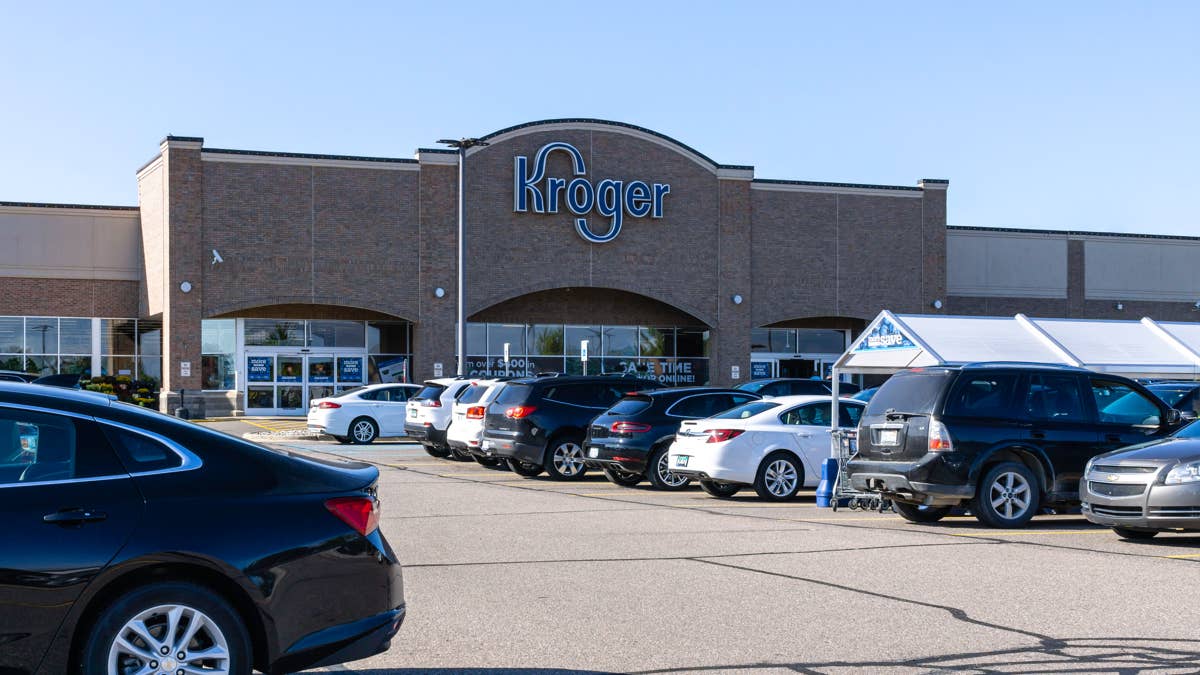
Kroger is facing mounting pressure from shifting customer habits, causing it to lose $12 billion as competition intensifies.
In recent months, the grocery chain, which operates regional supermarkets such as Ralphs, Fred Meyer, and Smith’s, has grown laser–focused on attracting and retaining price-conscious customers by offering more value and lower prices in its stores.
For example, it began offering extra savings on gas in March and refreshed its loyalty rewards program to include more simplified offers. In May, Kroger CEO Greg Foran confirmed plans to cut prices on thousands of items in its stores, a move that takes on Walmart, Costco, and other retailers emphasizing lower prices.
“The reality is, the basket has to come down,” said Foran in a Bloomberg report in May. “It needs to be across thousands of products, and it has to be something that passes the commonsense piece with customers.”
Kroger loses $12 billion in customer spending to rivals
Despite these efforts to keep customers away from rivals, Kroger has lost more than $12 billion in CPG (consumer packaged goods) spending to Amazon, Walmart, and Costco over the past year, according to a recent Numerator report.
Specifically, CPG spending at Kroger and Ralphs stores declined by $715 million and $516 million, respectively, as customers made 9 million and 5.5 million fewer trips than they did a year ago. Kroger incurred direct losses of more than $1 billion as a result of these shifts.
The retailer also added more than 1 million high-income households over the past year, but lost 700,000 lower-income households.
Related: Kroger drops new offer for customers as grocery prices climb
Lower-income Kroger shoppers pulled back their CPG spending by 5.2% year over year as they made 30 million fewer trips. The report notes that “low-income households are creating a $1B spending gap for Kroger.”
It also states that customer spending on grocery staples such as canned goods, beverages, and candy has increased by $800 million over the past year, while household items such as laundry, cleaning, and dishwashing supplies dropped by $97 million. Spending on health and beauty products was also down $178 million.
However, Kroger’s private-label brands across its fresh foods have become a source of growth, as customer spending in this area spiked by $420 million in the past year.
Kroger CEO reveals why customers are tightening their spending
Regarding this shift in customer behavior, Foran warned on an earnings call on Sept. 11 that Kroger customers continue to grow more cautious about their spending amid economic uncertainty.
“Customers remained under pressure, and that has affected the industry broadly. Unit growth has slowed since the start of the year,” said Foran. “Reductions in SNAP benefits, higher fuel prices, and softer consumer confidence are all putting pressure on household budgets. Customers are buying more on need.”
He said the consumer environment is getting “a little bit tighter” as shoppers grow more disciplined with how they spend their dollars.
“I would say that what we are seeing is the consumer continues to be disciplined,” he said. “They are not absent. They are turning up to the stores, but they are pretty disciplined about what they buy.”
In the second quarter of 2026, Kroger saw its identical sales without fuel increase 0.2% year over year, according to its most recent earnings report.
Recent Placer.ai data also found that customer visits to Kroger stores ticked up 0.5% year over year during the quarter.
Kroger invests in private label and organic to win over customers
Kroger Chief Financial Officer David Kennerley said on the call that “sales were softer” than the company expected during the quarter.
As sales grew slowly, Foran confirmed that Kroger’s private-label brands, such as Private Selection and Simple Truth, saw higher demand during the quarter, indicating that consumers are seeking lower price points and more value.
“Private Selection sales increased more than 14% during the quarter, driven by strong customer response to new products, including more ready-to-heat and ready-to-eat meals,” said Foran. “Across the portfolio, our brand sales grew faster than national brands.”
In response to this shift in customer behavior, Foran said Kroger is expanding its low-price-point brand, Smart Way, by adding more items and improving visibility in stores and online.
Foran also revealed that customers continue to “prioritize their health,” despite cutting back on discretionary spending, another trend Kroger is also further leaning into to boost sales.
“We continue to see strong engagement in natural and organic, and we’re responding by expanding the assortment across the store,” he said.
Foran said Kroger has doubled down on offering affordability during the quarter by working with suppliers and reinvesting cost savings and tariff refunds to offer customers lower prices.
“Customers have choices, and it is up to us to provide them with that choice,” he said.
Kroger shares a weaker sales outlook for 2026
As Kroger continues to navigate macroeconomic challenges, it has cut its full-year 2026 sales outlook.
Kroger now expects its identical sales (excluding fuel) to grow between 0.2% and 0.8%, down from its previous expectation of 1% to 2% growth.
“I would expect that the pressure is actually going to mount, and we’ve seen a little bit more in Q2 (second quarter of 2026) than what we saw in Q1 (first quarter of 2026),” said Foran.
More Grocery News:
- Publix struggles to reverse concerning customer behavior
- BJ’s Wholesale plans major store changes as customers pull back
- Target sees unexpected shift in customer behavior
The move comes after Evercore ISI analyst Michael Montani warned in a Reuters report in July that “industry trends and competition remain challenging for Kroger.”
The bleak sales outlook comes at a time when consumer sentiment continues to drop nationwide.
According to the University of Michigan’s Survey of Consumers data, consumer sentiment dropped 4 index points in preliminary results for September.
“With a resurgence in fuel prices and trade tensions, consumers anticipate greater pressures on their pocketbooks to come,” said Joanne Hsu, a University of Michigan economist and director of the Surveys of Consumers, in a statement.
Related: Publix makes significant checkout policy change for customers