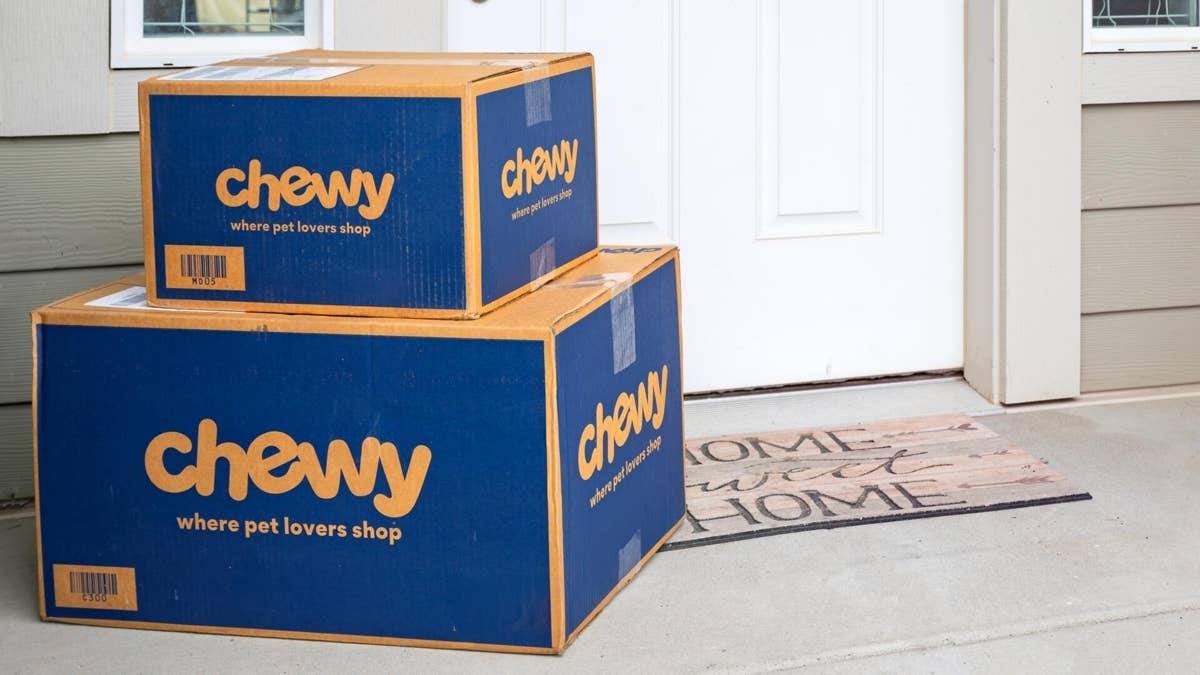
If you own a dog or a cat, you almost certainly have a Chewy box somewhere in your house.
Chewy has spent years building a loyal, subscription-driven customer base of pet owners who buy food, medicine, and supplies automatically, month after month.
You might be that loyal customer. But the problem right now is that even loyal pet owners are watching their budgets.
Morgan Stanley reviewed Chewy’s Q2 fiscal 2026 results in a note titled Managing Through the Treat-cession, which it shared with TheStreet on Sept. 9.
The firm cut its price target to $36 from $37 while maintaining its Overweight rating. CHWY closed the Sept. 9 earnings day down 11%.
The stock is down 36.22% year to date and 39.96% over the past year, according to Yahoo Finance. If you have been holding Chewy for five years, you are down a massive 71.89%.
Based on 17 Street analysts offering 12-month price targets for CHWY in the last three months, the average price target is $29, TheStreet noted.
“Treat-cession” is a wry description of the tougher macro backdrop facing pet spending in 2026.
Also Read: Chewy Inc. Latest News and Stories
What the Chewy quarter showed, and why the 11% sell-off was overdone
Chewy raised both its fiscal year 2026 revenue and EBITDA guidance. That should be a positive. But the market disagreed, selling the stock 11% in the session following the report.
Morgan Stanley’s note said the sell-off was an overreaction, but only partially, because the surface-level beat masked a more complicated underlying picture.
Q2 net sales of $3.33 billion grew 7.3% year over year, as noted in Chewy’s Q2 fiscal 2026 results. But strip out the inorganic contributions from SmartPak and Modern Animal acquisitions, and organic growth was 5.7%, decelerating approximately 120 basis points from Q1.
More Retail:
- Home Depot is making a big bet on cautious consumers
- Another state just banned a controversial retail pricing practice
- JPMorgan just flagged a slow-build food crisis
The EBITDA beat included roughly $15 million in one-time items that will not recur. Excluding those, the midpoint of fiscal year 2026 EBITDA guidance actually decreased by approximately 6 basis points. Stock-based compensation jumped 17% quarter over quarter, giving bears another talking point to question earnings quality.
“Given underlying fundamentals were in-line, we think the -11% move is overdone,” Morgan Stanley wrote in the note. “But it’s hard to argue for a meaningful re-rating until we see positive organic estimate revisions.”
The sell-off was too severe, but the stock will need evidence, not reassurance, to recover.
The pet macro that is weighing on Chewy’s whole story
The Covid pandemic sent pet adoptions soaring, and of course, consumers followed their new companions with their wallets. Pet spending had one of the most remarkable runs of any consumer category through 2020 to 2022, the American Pet Products Association reported.
That time is gone. And household budgets are getting tighter lately. Costs of everyday essentials, including food, housing, and utilities, are rising.
As a pet owner, you are likely to spend less or more carefully, trading down in some categories or even stretching the interval between purchases in others, if that’s your priority. But I don’t think anyone would bring in another companion when they don’t have enough in the fridge for themselves.
Related: Team Dog or Team Cat? What Pets Reveal About Retirement
Morgan Stanley’s view is that the weakness has stabilized at an organic growth rate of approximately 6% year over year. It treats it as the right baseline for the business, given current macro conditions. It seems to be more of a holding pattern, waiting for something to break the range.
Well, there’s some good news for Chewy bulls, according to Morgan Stanley. Remember, Chewy expanded its pet healthcare and services ecosystem by acquiring the veterinary platform Modern Animal in April 2026 and the equine health brand SmartPak (SmartEquine) in late 2025.
The acquisitions added $100 million and $80 million in fiscal year 2026 revenue, respectively, according to Morgan Stanley’s modeling.
Veterinary clinic expansion continues. The healthcare business, which carries higher margins and stickier customer relationships than commodity pet food, is growing.
Chewy+ redesign, the catalyst Morgan Stanley is watching
The most interesting forward-looking element in Morgan Stanley’s note is the redesigned Chewy+ membership program. Management described it as launching “very shortly.”
The program’s redesign is the one idiosyncratic catalyst in the story that is not dependent on macro improvement.
If Chewy+ demonstrates promising early adoption in the second half of 2026, Morgan Stanley believes the company could lean into the program aggressively in fiscal 2027 to drive top-line acceleration — even accepting a near-term margin offset to do so.
Fiscal 2027 is where we have the real debate. Morgan Stanley estimates Chewy will target approximately 15% to 18% incremental margins in fiscal 2027, translating to roughly 50 to 70 basis points of EBITDA margin expansion at the firm’s estimated 6.4% revenue growth.
That expansion rate is below the approximately 100 basis points Chewy has been adding, which means the market needs to see either faster revenue growth or higher margin expansion before re-rating the stock.
Morgan Stanley’s DCF points to a $36 price target, based on 7% revenue growth through fiscal 2030, long-term EBITDA margins of roughly 10%, and an 8.5x fiscal 2027 EBITDA multiple that the firm considers attractive.
The bull case gets to $55, but Chewy would need to deliver 8% revenue growth, successfully scale Chewy+ and its clinics, and expand margins to 13%. The bear case falls to $14, assuming just 4% revenue growth and continued competitive pressure.
At around $21, Chewy trades at an estimated 8.5x fiscal 2027 EBITDA, while Morgan Stanley expects EBITDA to grow at a 16% CAGR through 2029. In other words, the stock appears priced for continued underperformance, not the recovery implied by Morgan Stanley’s Overweight rating.
The catch is that a meaningful re-rating likely requires organic growth estimates to start moving higher. Chewy’s provision of that catalyst in the second half of 2026 could determine which of these scenarios ultimately plays out.
Related: Pet costs are soaring — and owners can’t keep up